Thomas Cole House Honors Art Historian Barbara Novak

Barbara Novak reflects on her distinguished career.

Barbara Novak reflects on her distinguished career.

Anyone seriously interested–and I don’t only mean professionals, but also people like me who are amateurs in the true sense of the word–in 19th-century American landscape painting owes a huge debt to Barbara Novak, whether or not they are even aware of it. As a doctoral student researching in Europe in the mid-1950s for her PhD dissertation on 15th-century Flemish art, Barbara Novak decided to defy convention and switch her topic to the Hudson River School artists Thomas Cole and Asher B. Durand. Completing her dissertation in 1957, she joined the faculty of Barnard College the following year, and thus began a long and distinguished career of research, writing, teaching, and mentoring new research students, all of which compelled the art world to take seriously a topic that until then was virtually completely ignored. Her book trilogy Nature  and Culture: American Landscape and Painting 1825-1875, American Painting of the Nineteenth Century: Realism, Idealism, and the American Experience, and now Voyages of the Self: Pairs, Parallels, and Patterns in American Art and Literature are classics in the field.
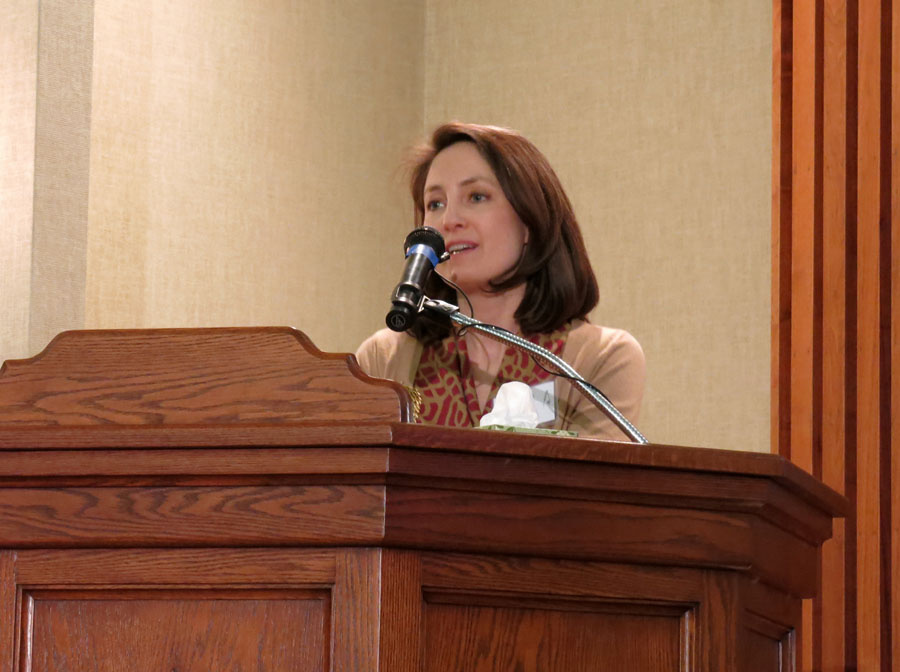
Elizabeth Jacks, Executive Director of the Thomas Cole National Historic Site, offers a welcome to the audience.

Elizabeth Jacks, Executive Director of the Thomas Cole National Historic Site, offers a welcome to the audience.

On Sunday April 14, the Thomas Cole National Historic Site honored Barbara Novak’s outstanding contributions to American art scholarship with a program in her honor, in which leading art scholars Ella M. Foshay, Annette Blaugrund, Adrienne Baxter Bell, and Karen Wilkin, along with literary scholar H. Daniel Peck and photographer Susan Wides each paid tribute to Dr. Novak and explained her influence on their own lives and careers. A true Renaissance woman, Dr. Novak is also a poet as well as a painter, and fifth-grader Isaac Barnes, the son of Thomas Cole Site Trustee David Barnes, read a selection of her poetry with stunning poise. Her husband, artist, author, and art critic Brian O’Doherty, was also on hand to pay special tribute to his remarkable wife–he referred to the “Barbara Diaspora”–“her students are everywhere.”
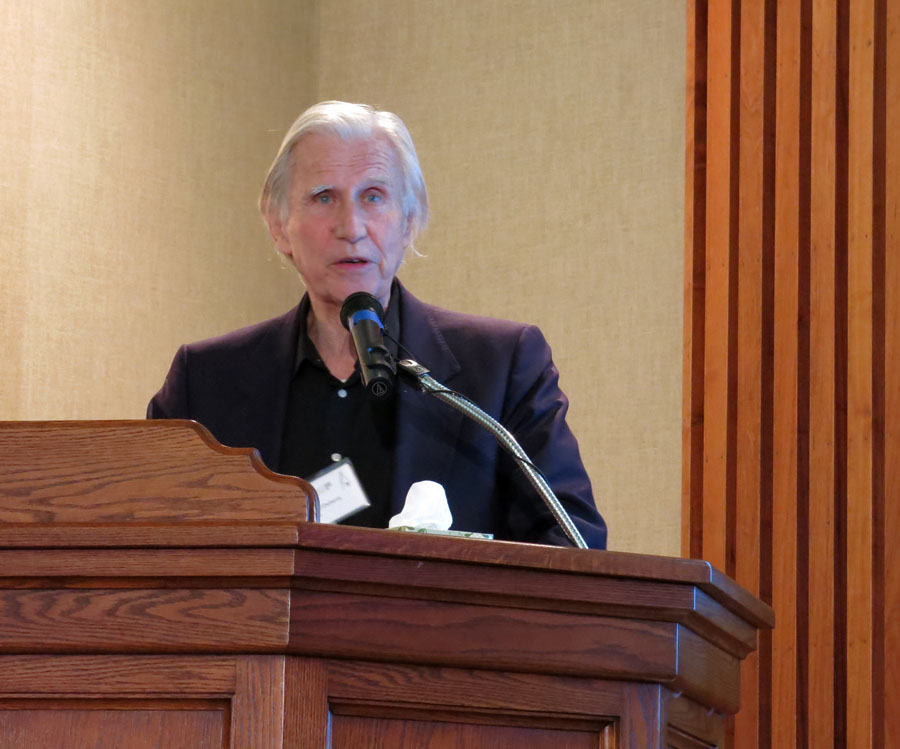
Brian O'Doherty, Dr. Novak's husband, said that no one can claim to have been more influenced by her than he!

Brian O’Doherty, Dr. Novak’s husband, said that no one can claim to have been more influenced by her than he!

Finally, Dr. Novak herself offered her own reflections on her life and career. A painter herself even before embarking on the academic study of art history, she was overwhelmed at the thought that her own paintings of flowers were now hanging in Thomas Cole’s house: “I hope he doesn’t mind,” she said. About Cole, whom she called “one of the great intellectual artists” in America, she commented that it’s impossible to exhaust his riches in a lifetime.

One has to admire not only the breadth and depth of learning and reflection Dr. Novak has brought to her chosen area of study over the years, but also the vision of the young doctoral student who, on a Fulbright grant in Europe, noted that “there were plenty of 15th-century Flemish scholars doing the same things over and over,” saw the potential in doing something new, and embarked on a lifetime study of the group she calls “my guys”–Cole, Durand, and their colleagues.

Isaac Barnes shows another side of Dr. Novak by reciting some of her poetry.

Isaac Barnes shows another side of Dr. Novak by reciting some of her poetry.

On Sunday April 28, one of the speakers at Dr. Novak’s tribute will take the podium in her own right: Annette Blaugrund, curator of the 2013 exhibition at the Thomas Cole Site Albert Bierstadt in New York & New England, will introduce the exhibition with a lecture at 2 pm. This is followed by a reception and open house from 3 to 4 pm. Why not take this opportunity to make the acquaintance of one of the leading exponents of the second generation of Hudson River School Artists?

Hudson Valley Celebrates with St. Patrick’s Day Parades

Ed IMG_1272 s

Towns all over the Hudson Valley from Westchester to points north have been celebrating St. Patrick’s Day with their own local parades. Many of those parades take place before the big one in New York City — this gives revelers a chance to enjoy the city festivities as well as their local parade, and many of the participants, especially the bands, to do the same.

On Sunday March 10 I took in the St. Patrick’s Day Parade in the town of Eastchester in Westchester County. I was amazed at the number and variety of participating groups — bagpipe and other bands, high schools, schools of Irish dance, churches, all manner of vintage cars, public services such as the police, Fire Departments, EMS, all marching down the main street and cheered on by the enthusiastic onlookers in a parade that lasted one and a half hours. Little kids, big kids, even the dogs were wearing green! A great day for the Irish and the Irish wannabees of Eastchester and the surrounding towns of lower Westchester.

Here are some photos.

Vintage cars took part

Vintage cars took part

and wagons drawn by Heavy Horses took part.

and wagons drawn by Heavy Horses took part.

Boy Scouts ...

Boy Scouts …

... and Brownies.

… and Brownies.

High schools marched, such as Cardinal Hayes here, proudly bearing their banners.

High schools marched, such as Cardinal Hayes here, proudly bearing their banners.

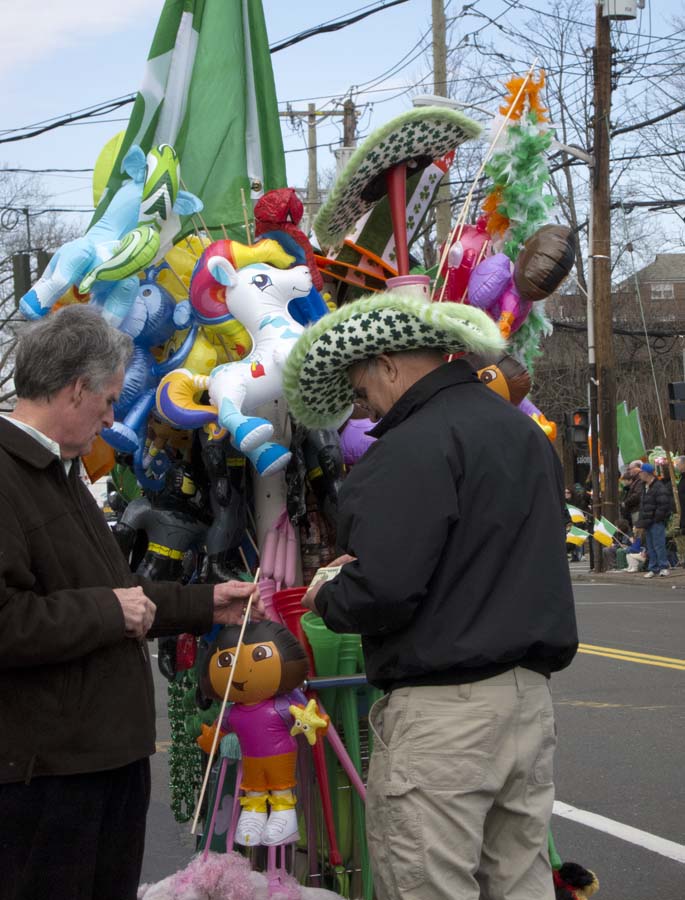
The vendors were kept busy. Everyone wanted something green!

The vendors were kept busy. Everyone wanted something green!

Met Opera’s Parsifal a Treat at Kingston UPAC

Ed IMG_1245 s

Last Saturday  I had the amazing experience of enjoying the Metropolitan Opera’s new production of Wagner’s Parsifal live in HD at the UPAC in Kingston.  The production was not a traditional one but was set in the present–or, perhaps, a future–time. It certainly had a postapocalyptic feel to it. And it worked. The point: This is a timeless story, not something that could only have taken place in a mythical Middle Ages.

The cast was the best that could have been assembled for a Wagner opera in this day and age: it included Jonas Kaufmann (Parsifal),  Katarina Dalayman (the sorceress Kundry), Peter Mattei (the wounded Grail Knight Amfortas), and Evgeny Nikitin (the evil magician Klingsor), led by the masterful conducting of Daniele Gatti, but for me the most memorable performance came from the great Wagnerian bass Rene Pape as an unusually youthful, deeply sensitive Gurnemanz.

Although I’ve been a professional opera critic in a precvious life, my purpose in this blog post is not to comment in detail on the performance but, rather, to highlight the venue–the UPAC in Kingston. For me, at least, this historic theater was an undiscovered treasure, since until I went looking for a place to see Parsifal I had never heard of it. Thus as a Wagner lover and a historian, it was a double treat to attend the performance here. Originally known as the Broadway Theater (it’s on Broadway in Kingston, a few minutes from I-587), this combination movie palace and vaudeville house first opened its doors in 1927. Twenty years later it was purchased by the Walter Reade Organization and became a first-run movie theater. In 1953 the theater got not only a major facelift but also a new name, the Community Theater.

Ed IMG_1252 sIn the 1970s Kingston began suffering from an all-too-common malady as businesses and entertainment venues forsook town centers for suburban mall areas, and by 1977 the theater was slated for demolition–until a group of concerned citizens got together, purchased it, and reopened it as the Ulster Performing Arts Center (UPAC). In 1979 the theater went on the National Register of Historic Places, one of the last great show palaces in New York State. The UPAC is now merged into the corporate structure of the Bardavon, another historic theater across the river in Poughkeepsie, both of them premier performing arts venues in the Hudson Valley.

The variety of offerings at the UPAC is quite amazing, as you can see from the photo here.  If you visit their website, you can learn about their performance schedule and also become a Friend, which entitles you to various “perks” depending on the level at which you join. The membership covers being a Friend both of the UPAC and the Bardavon, so you get two for the price of one.

It just goes to show that people living in the Hudson Valley don’t have to schlepp into New York City for top-notch performances. While operagoers watching HD live aren’t seeing the performances in person, the huge screen ensures that they have a better view than they would at the Met, plus–and this is a major bonus as far as I’m concerned–they get to see the live intermission interviews with the artists, something the Met audience misses out on.

Check out the UPAC and the Bardavon today. I guarantee you, there’s something at each of them for every taste–and you’ll be supporting a historic artistic presence in the Hudson Valley.

Thomas Cole Historic Site Opens Its 2013 Sunday Salon Series

The Sunday Salons are always my favorite event at the Thomas Cole National Historic Site. These presentations, each by an expert in their field, are a great way to learn more about Thomas Cole and the other artists of the Hudson River School as well as to meet up and chat with familiar faces and to meet new people who share your interest in Cole and his friends.

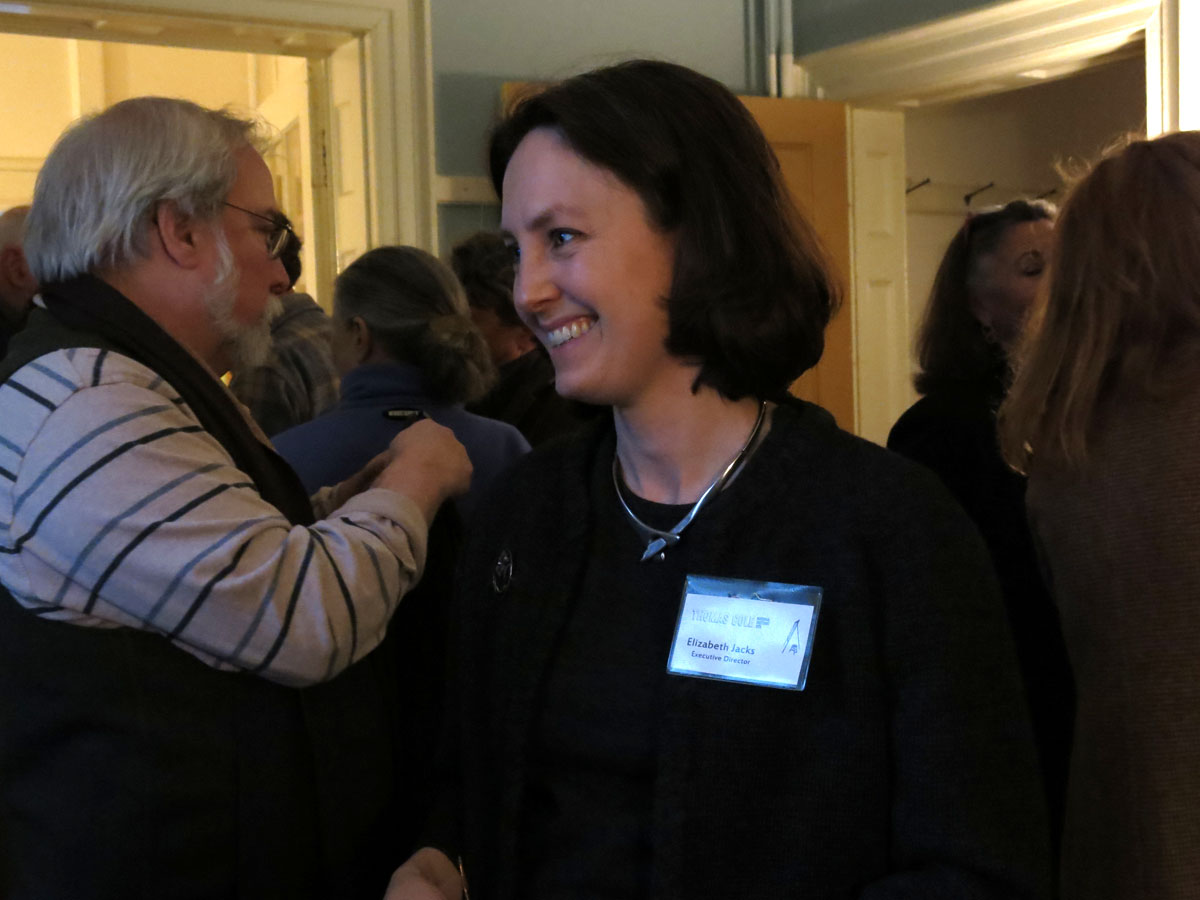
Elizabeth Jacks, Director of the Thomas Cole National Historic Site, greets visitors at the Sunday Salon reception.

Elizabeth Jacks, Director of the Thomas Cole National Historic Site, greets visitors at the Sunday Salon reception.

The 2013 Sunday Salon season began with an illustrated lecture by Kevin Avery on “Cole and the American Revolution in Landscape.” Dr. Avery, Senior Research Scholar at the Metropolitan Museum of Art in New York City, is no stranger to Cedar Grove and his talks are guaranteed to be outstanding. This time his starting point was the insight that “our [the American] wilderness was not always our mecca, but our dread.” It was threatening–a place to be feared.

Cole’s originality lay in avoiding the pleasant and orderly depiction of  landscape and, instead, confronting the dread head-on by depicting, in his paintings, that which was feared. His early Kaaterskill Falls, one of three paintings that astounded the artist JohnTrumbull when he saw them in a Lower Manhattan gallery, is an excellent example. This was an era when consciously exposing oneself to something thrilling or frightening–Coleridge’s deliberately dangerous descent of Sca Fell comes to mind–was becoming the fashion, and whether intentionally or not, Cole played into this trend.

Particularly fascinating to me were the illustrations that showed not only Cole’s own paintings (and those of his Hudson River colleagues and epigones) but also those of his European forebears–the established artists whose techniques Cole was able to adapt for his own aesthetic. No matter how original or how revolutionary, no artist–whether visual, musical, or literary–suddenly springs up like Venus fully armed from the head of Zeus (a pity the musicologists who made their careers writing about composer Hector Berlioz in the 1960s and ’70s preferred for the most part to ignore this), but, rather, learned from their predecessors and developed and adapted what they learned. The predecessors may have been famous–in Cole’s case one thinks of Salvator Rosa, from whom he got the idea of incorporating blasted tree trunks into his landscapes, or Claude Lorrain, paragon of the “beautiful” aesthetic–or they may have been obscure, but we do wrong to ignore this historical dimension of an artist’s work and thereby decrease our potential for understanding them.

As an English immigrant, Thomas Cole was conversant with English landscape techniques and so was able to adopt them for his own use. Similarly, Albert Bierstadt, having come to America from Germany where he painted the Alps, was well suited to paint the Rocky Mountains. This is the kind of information that really enhances one’s enjoyment of the artists one admires.

The remaining Sunday Salons will be held on February 10, March 10, and April 14–this last one absolutely not to be missed because it will be devoted to Barbara Novak, aptly called “Pioneer in American Art History.” For more information please visit the website–I wonder what Thomas Cole would think if he were to come back and learn that he has a website.

Another local note: Before making my way to Catskill for Dr. Avery’s presentation, I drove up to the village of Athens fourEd IMG_0523 blog miles up the road (Route 385) to enjoy its historic architecture, the Athens Rural Cemetery (with such familiar and famous names as Van Tassel), and, finally, lunch in the lovely Riverside Cafe down on the aptly-named Water Street. If you’re coming from a distance, you might want to incorporate this walking tour into your day.

Hudson Valley Holidays and Favorites of 2012

IMG_0448 sEd IMG_0452 s


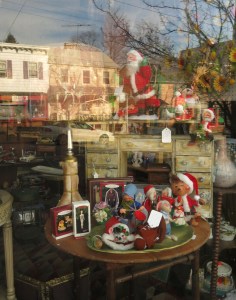
On a walk through Woodstock the day after Christmas I happened to have my Canon Powershot G15 with me and so I photographed some of the decorations in the shop windows and on the lawns. No great masterpieces (being in Woodstock on a weekday midday doesn’t lend itself to that, though it is lots of fun!), but here are two shots from my favorite window in all of Woodstock. For one thing, its position where the historic church can be seen reflected in the window makes it very interesting indeed; for another, the colorful items in the window, especially at Christmas time, tend to remind me in the scene near the beginning of the Alistair Sim version of A Christmas Carol where Tiny Tim is ogling the toys in the window of the toy shop. (Although — am I the only one who finds something slightly sinister in that scene?)

My favorite photos of 2012 are now posted in a special gallery on my website: an even dozen, of which some, of course, are from the Hudson Valley.  All photos in this gallery are my Prints of the Month for January. That means not one but twelve pictures available at the special Print of the Month prices. It’s a good time to purchase,  because all my prices will increase slightly in February.

Here’s a preview for you — two of the photos, one of Cooper Lake and one of an old barn in Spruceton Valley. Click on either of them or on this link to visit the gallery and see all twelve.

C DSC0031 sA DSC0504 s

Cold Spring Christmas

Here is another mini-collection of photos of Hudson Valley towns decked out for the holidays. This time it’s Cold Spring in Putnam County.

IMG_0375 blog

The reflection of the decorated shops across the street in the window of one of Cold Spring’s wonderful antique shops gives a “two-for-the-price-of-one” image.

IMG_0383 ed blog

This cheerful snowman greets passersby outside my favorite Cold Spring cafe.

IMG_0386 ed blog

One of Cold Spring’s premier restaurants boasts not only a river view, as its name indicates, but also a stunning view of Storm King Mountain, as you can see, on the other side of the Hudson.

New Paltz — Decked Out for Christmas

With Christmas just around the corner I thought it would be fun to visit some of my favorite Hudson Valley towns and see how some of the stores are decorated. Here is a sample from New Paltz.

IMG_0371 sThis set of colorful stick figures that always greet visitors at the entrance to the famed Water Street Market is currently sporting Santa Claus caps.

IMG_0372 s

Many of the shop windows in the Water Street Market are decorated with this “gift-wrap” theme. The photo includes a reflection of the shops on the opposite side of the pedestrian path.

IMG_0373 s

My favorite place in all Water Street — the gallery of regional photographer G. Steve Jordan. If you’re in New Paltz, stop in for a real visual treat. Otherwise, visit Steve’s website. Anyone who has been to the Mohonk Mountain House should appreciate one of Steve’s prints of the area as a remembrance of their visit. One of his magnificent 2013 calendars will keep the memories alive on your wall all year long.

Burger Hill Park offers great “prospects”

In 18th-century (and early 19th-century) England the word “prospect” was often used to mean “view,” and people enjoyed going out walking and hiking to find nice prospects. They would ascend high hills to enjoy the prospect; apparently, this is how one accessed the best view–oops, I mean prospect–of the university town of Oxford. Poets often waxed eloquent in praise of prospects (the well-known phrase “Distance lends enchantment” comes from one of these poems).

Those searching for an interesting “prospect” in the Hudson Valley might well consider a trip to Burger Hill Park near Rhinebeck. Burger Hill offers stunning views of the Hudson Valley and Catskills and of the surrounding, bucolic farmland, and is especially attractive during the foliage season, as you’ll see from my photos. I understand that it’s a great place for sledding during the winter, and during the spring and summer birdwatchers have plenty of opportunities for their favorite activity. In fact I noticed several nesting boxes built at various places and wondered what species they attract–possibly meadowlarks?

Burger Hill has an interesting history. In the early 18th century a man named Burkhardt, a Palatine German who settled in this region, became a tenant farmer of Henry Beekman (maybe you’re familiar with the fine Beekman Arms restaurant in Rhinebeck), who acquired the land in 1679. Ownership eventually passed to the original tenant’s descendants, whose name over the years evolved to Burger. The property passed on to a series of different owners until it was sold to Scenic Hudson in 1997. Currently it is managed by the Winnakee Land Trust.

To enjoy the views you need to climb the 550-foot-high hill. There are three ways to do so, two gradual ascents (of which the one to the right is the more scenic) and one direct, unrelentingly steep path, which I don’t recommend unless you are quite certain you’re in the best of shape. You’ll find benches here and there and, at the top, stones into which are carved the shapes and names of the mountains visible on the opposite side of the river to help you identify them.

Burger Hill is reached by driving south from Route 199. The turn-off, which is on the right, isn’t too far after the junction with Route 9G which leads into Rhinebeck. After you’ve scaled the hill and enjoyed the view, you might want to treat yourself to something at one of the nice cafes in town.

These and other photos of the Hudson Valley, Catskills, and my other favorite places can be viewed and purchased on my website.

Lively Arts Scene on the Mountaintop

On a recent Sunday afternoon I drove up to the Mountaintop region of Greene County—the villages along Route 23A—to check out what was happening, especially since some interesting art events were available. My first stop: XTreme Barns and Beyond, an exhibition of photographs by Richard Schepper at the Kaaterskill Fine Arts Gallery in Hunter. Be prepared to be surprised; intrigued; to wish the photographer were there so you could ask, “But how … ? Why … ?” Whatever — you will definitely not be bored. A gifted photographer of nature scenes both stunning and serene, Richard Schepper pushes the envelope when it comes to walking (or blurring) the lines between photography and painting. Don’t miss his show; it closes October 28.  Kudos to the gallery and director Carolyn Bennett for hosting this challenging exhibition.

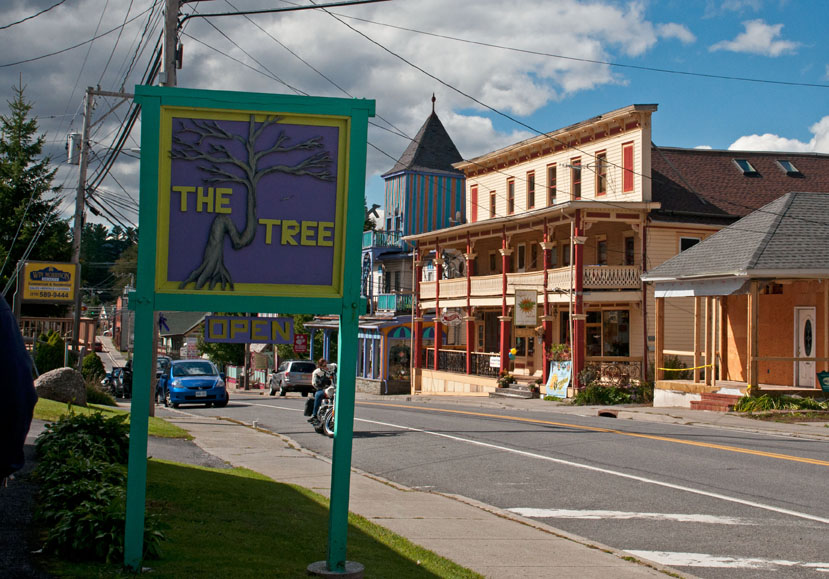
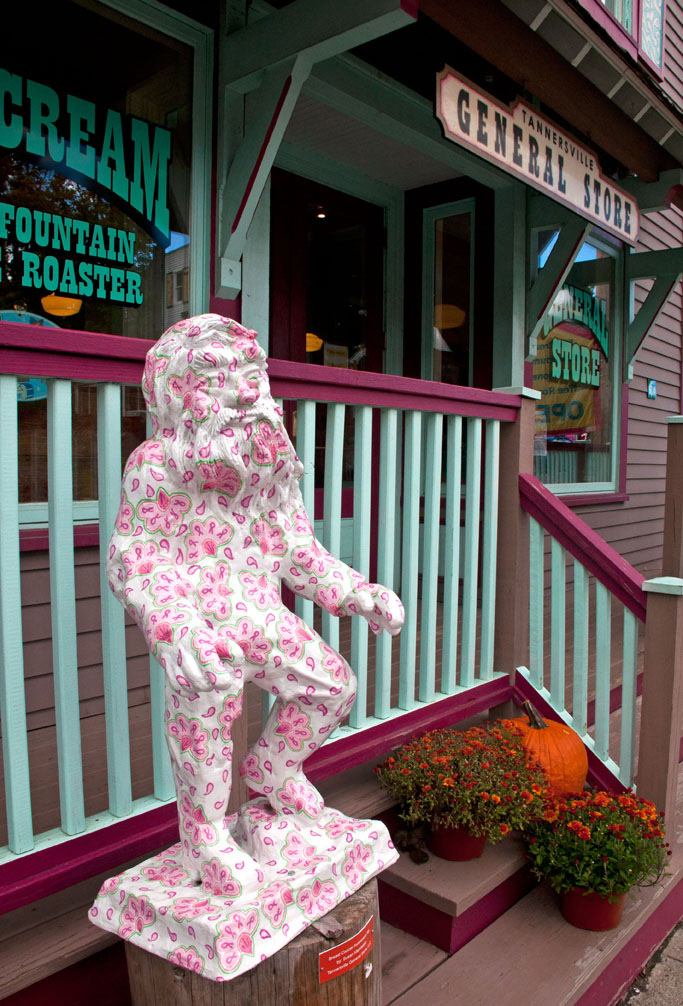
My next “art” destination was Catskill and Thomas Cole’s House, but first I stopped in Tannersville to enjoy the colorful buildings on Route 23A. Tannersville is the mountaintop place for restaurants. This picture shows Susan Kleinfelder’s Rip van Winkle “Breast Cancer Awareness” statue outside the Tannersville General Store, one of many artistic renditions of ol’ Rip in  “Rip Lives 2012,” the third annual such event sponsored by local Mountaintop businesses.

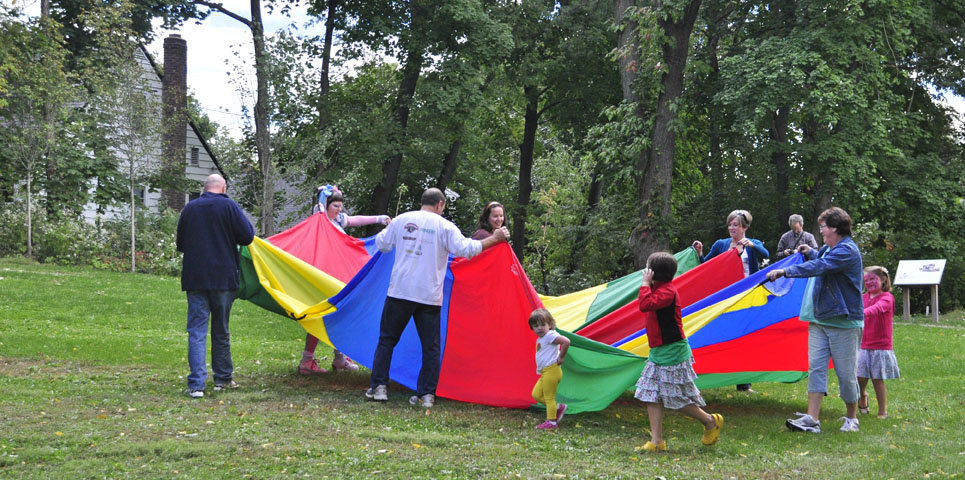
The Thomas Cole Historic Site was holding its annual open house, always a good time to enjoy free admission to Cole’s house and studio (including the special exhibition of the year) and a variety of entertainment and other activities for all ages.  I interviewed Thomas Cole himself (a.k.a. Catskill Mayor Vincent Seeley), who was gratified to see such an enthusiastic turnout and amazed to learn that he had such a thing as a Website. The 2012 special exhibition features landscape paintings by 19th-century artist Louis Rémy Mignot. Mignot produced a variety of masterpieces in his tragically short life; having just seen Richard Schepper’s daring exhibit in which several of the photos looked more like paintings (Braque came to mind), I was now face to face with a painting—Mignot’s  View Across the Valley of Pierstown —that could well have been mistaken for a photograph. Art is amazing. And here are some photos from the event:

Mountaintop Historical Society Holds Archives Day

One of the older buildings on the MTHS campus in Haines Falls

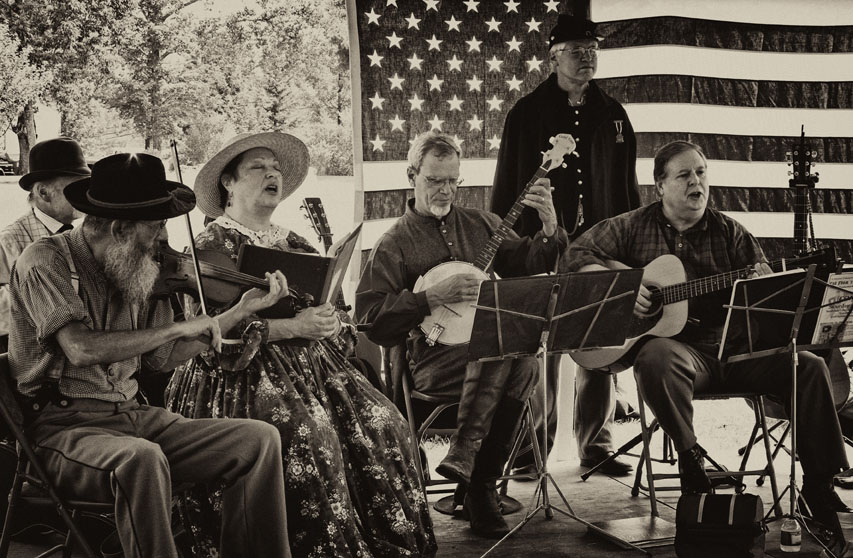
The Balladeers were delightful to hear.

The weather for this year’s Mountaintop Historical Society’s Open House–called Archives Day this year–could hardly have been more different from 2011, when the lashing rains of Hurricane Irene arrived right in the middle of the events. Now, Saturday August 25 was bright and sunny, perfect weather for this annual outdoor event. The 77th New York Regimental Balladeers gave stirring and thoroughly enjoyable renditions of Civil War-era songs, the MTHS archives were on display in the Visitors Center for all to see, and well-known local geologist Dr.

Local historian and author John M. Ham poses with his latest book. The quality of the B&W photos in this one is amazing.

Robert Titus presented a highly informative (and illustrated) lecture on the geological aspects of Hurricane Irene. Far from being information for information’s sake, what Dr. Titus had to say was vital knowledge for town planners if similar disasters are to be avoided in future.

I encourage you to check out the MTHS by visiting their website. Located in Haines Falls along Route 23A, the MTHS campus is easy to find and a delight to visit. They frequently offer interesting programs, including hikes. If you live near the area or enjoy driving

Cheerful, dedicated volunteers serve food!

through Kaaterskill Clove (or up the scenic Route 214 to the west), I think you’ll enjoy the MTHS. Why not become a member?

_____________________

SPECIAL OFFER FOR MY PHOTOGRAPHY FANS! It’s never too early to think about Christmas and holiday gifts (including something for yourself!). Until the end of October I’m offering Free Shipping (to USA only) on the Hudson Valley/Catskills matted prints, including the beautiful 16 x 20 framed print of Cooper Lake Sunrise, to be ordered from my Etsy Store. There are limited quantities of these items, so please check it out soon.